Weekly Technology Brief #1

From Bigger Models to Bigger Systems

8 October 2026

Dear readers,

If there is one idea running through this week’s technology news, it is that the interesting action is moving outward. AI is no longer just a story about better models (this has, arguably, been the case for the best part of 2026 so far). The constraints, opportunities and risks are increasingly appearing in the systems around them. This includes the agents that act on our behalf, the memory chips that enable lots of the fancy work, the electricity that keeps the data centres running, the biological datasets that let the models reason about living systems, and the verification machinery needed before we trust claims about quantum computers, autonomous robots, or the incredible number of mathematical proofs thrown at the scientific community.

That shift matters because it changes the question. Instead of asking only, “Which model is smartest?”, we increasingly need to ask: What infrastructure makes the intelligence useful? What becomes the next bottleneck? And, perhaps most importantly, how do we know that the system actually works outside a carefully controlled demonstration (this last one itself deserves a deep dive soon)?

Google Cloud used its Gemini at Work event this week to introduce what it calls a single universal Gemini agent for work. The important part is not that the agent can answer questions, create content or write code. After all, we have seen plenty of that already. The more interesting part is where Google is putting the surrounding machinery.

The agent is designed to operate across Gmail, Drive, Docs, Slides, Sheets, Chat and Calendar, while carrying business context between them. Google is also emphasizing identity, permissions, authorization, secure sandboxing, network gateways, policy management and spending controls. In other words, the product is beginning to look less like a clever chatbot and more like an employee operating inside an institutional control system. At least that is the idea. Whether or not any of the individual angles are well covered is a matter of further verification and a source of more articles!

However, this is an important transition. A model that occasionally produces a bad answer is irritating. An agent with permission to send an email, alter a spreadsheet, query confidential data, execute code or initiate a business process can create a very different class of problem. As the ability to generate actions becomes cheaper, the value of deciding which actions are permitted, and independently checking what actually happened, should rise. Also, let’s not forget that verifying, and ultimately pulling the plug on, a model generating a single wrong answer is easy. Once an agent gets to work, the potential for generating nonsense also scales and it becomes quite possible that by the time we know what is wrong the extent of the any damage cause could be truly substantial.

In any case, the transition means that the emerging stack may actually look something like this:

The model companies will naturally compete on intelligence. Enterprises, however, may eventually care just as much about the layers around that intelligence, including identity, audit trails, rollback, cost control, data sovereignty and liability.

As a result of this transition, intelligence itself may become abundant, but trustworthy control probably may not necessarily follow the same trajectory.

The physical side of AI became unusually visible this week when Google announced a major agreement with Constellation Energy. The arrangement is intended to unlock 890 megawatts of additional nuclear capacity through upgrades to 11 reactor units across six existing U.S. nuclear plants. Google says its agreements involving uprates and reactor restarts have now enabled more than 1.5 gigawatts of new nuclear capacity.

The interesting detail is that this is not primarily a story about waiting for futuristic small modular reactors. Google is financing improvements to infrastructure that already exists. That is revealing. When electricity demand is rising quickly, the fastest new megawatt may be the one squeezed out of an existing asset rather than a completely new power station.

This is another example of the bottleneck migrating downstream. Better AI models create demand for more accelerators. More accelerators create demand for memory and networking. More servers create demand for data centers. Data centers create demand for power, cooling, land, grid connections, permits and financing.

Build this, and that becomes the next bottleneck!

The implication is broader than nuclear power. AI infrastructure is becoming an industrial system, and industrial systems are constrained by things that software companies historically did not have to worry about quite so much, such as turbines, transformers, transmission lines, water, construction schedules, local communities and the cost of capital. The future of AI may still be written partly in code but an increasing amount of it will be built in concrete and copper. Sounds strangely poetic, right? 😊.

Samsung’s preliminary third-quarter results provided another reminder that the AI boom is not confined to GPU vendors. The company projected operating profit of 107.4 trillion won for the quarter, nearly nine times the level a year earlier (12.17 trillion), with strong demand and tight supply in memory playing a central role. Detailed results are still to come later this month, so the precise divisional picture deserves some patience.

The more useful lesson is structural. Modern AI accelerators can perform extraordinary numbers of calculations, but those calculations are useful only if data can be moved to and from the processors quickly enough. That is why high-bandwidth memory has become such an important part of the AI system, and why conventional DRAM and NAND conditions still matter as capacity is redirected and supply remains tight.

There is also a warning here. Extraordinary earnings do not prove that extraordinary growth continues indefinitely. Semiconductor markets have a long history of turning shortages into investment, investment into capacity and capacity into eventual oversupply. AI may have changed the scale of demand, but it has not repealed economics. In other words, the inherent cyclicality of memory products remains a real risk for investors.

So, the question is not simply whether memory demand is strong. It plainly is. The better question is whether supply can expand faster than AI workloads broaden. And where the constraint moves if memory becomes less scarce. Networking? Advanced packaging? Power? Capital? This is why following bottlenecks is often more informative than following product announcements.

We used to say (well, I used to have this as my LinkedIn moto for a long time): In data we trust. As an investor, especially in the crazy age of AI one should say: In bottlenecks we trust!

One of the most interesting developments of the week came from biology rather than the usual AI laboratories. The U.S. government, Biohub, Meta, Google DeepMind and Isomorphic Labs are participating in a roughly $1.8 billion effort to build large, standardized datasets for AI-driven biological research.

This matters because biology exposes one of the weaknesses in the familiar internet-era AI story (let me be clear: Weakness in this context is not exactly a negative word. If you get biological data wrong and then use it to make a decision that may subsequently prove wrong, people may die. I mean, literally. That is why anything to do with biology has been traditionally more regulated and, by definition, slower. And yes, that includes data availability. While there is always room for improvement everywhere, including in biology, expecting every industry to run under the start-up maxims of “break it first and see where it ends”, or “fail fast” is not exactly advisable!). Language models benefited from enormous quantities of text that already existed. In biology, the most valuable training data may not exist yet. Researchers have to create it through experiments. This is not my area of expertise but I read this includes perturbing cells, measuring what happens, standardizing the observations, then training models, generating new hypotheses and finally running more experiments.

In other words, the loop becomes:

Each cycle uses the evidence generated by the previous one to refine the next question and experiment.

That is potentially much more consequential than simply attaching an AI assistant to a laboratory (there is nothing wrong with the AI assistant but, eh!). If models can help decide which experiments are most informative, and automated laboratories can execute those experiments at scale, scientific discovery itself becomes a closed learning loop. Granted, scientific discovery was always expected to be loopy (using feedback to refine questions and experiments) so, the concept may not be new. What is new is our ability (thanks to modern AI) to accelerate and increasingly automate parts of that loop, and to do it at scale.

But there is an important discipline to maintain here. A better biological model is not a medicine. Neither is a plausible mechanism the same as a clinical outcome. Drug development still has to cross the brutal sequence from biological insight to candidate, preclinical evidence, human safety, efficacy and eventually scalable treatment (I just told you about the regulations and the slower pace of change in biology, did I not?). AI may accelerate parts of that chain without magically eliminating the chain (I am, assuming, that biology will not fall into a Muskian loophole any time soon. Remember DOGE?).

Quantum computing produces no shortage of impressive announcements (on a personal note, and as a Physics graduate, I have to admit that there is a lot to be excited about in this field these days. It is so, very, grooooovy!). This week’s more interesting development was deliberately less glamorous though: DARPA moved Atom Computing, Diraq, IBM and IonQ into Stage C of its Quantum Benchmarking Initiative. They join Microsoft and PsiQuantum, which had already reached the equivalent final evaluation stage.

DARPA’s question is refreshingly concrete: Can any of these approaches produce a utility-scale quantum computer whose computational value exceeds its cost by 2033 (as I said in my separate intro before publishing this very first weekly brief, my aim is NOT to give my readers investment advice. I am simply not an expert in that. But the investor in you may want to pay attention to the clear deadline introduced here. What might credible progress, or failure to make it, mean for company valuations between now and 2033? Now, that is an interesting question.)? Stage C moves the emphasis from roadmaps toward verification and validation of the hardware and systems as they are built.

That is exactly the kind of pressure the field needs. Qubit counts, fidelity records and elegant demonstrations are useful evidence, but none alone tells us whether a machine can solve economically valuable problems reliably enough, at sufficient scale and at acceptable total cost.

The deeper pattern is worth watching beyond quantum:

As technology becomes more powerful and the financial incentives to announce breakthroughs become larger, verification itself becomes valuable infrastructure (who will do the verification? Does this smell like a possible business opportunity, I wonder!).

A recent, smaller announcement this week may be more important than many flashy humanoid demonstrations. Agility Robotics and FORT Robotics expanded their work on a safety architecture for Digit 5, including interfaces that connect the robot to external safety systems.

That sounds less exciting than a humanoid folding laundry or performing acrobatics (and even less exciting than a video of a humanoid folding laundry while performing acrobatics!). But I say that is good. In fact, bring more of this type of news on! I learned a long time ago that real deployment is supposed to become boring. Else, the said deployment may not be nearly as reliable as one would hope.

A robot operating beside people in a warehouse or factory needs more than an impressive policy model. It needs predictable emergency behavior, communications with external (or 3rd party) safety infrastructure, clear operational boundaries and ways for humans or other systems to intervene. The relevant scoreboard therefore should not be “How human-like did the demo look?” but something closer to useful task completion, autonomous operating hours, intervention rate, safety incidents and cost per useful hour.

Physical AI will become interesting when robots stop being primarily demonstrations of capability and become dependable pieces of infrastructure.

Taken separately, these stories concern enterprise software, nuclear energy, memory chips, biology, quantum computing and robotics. Taken together, they point in the same direction.

We spent the first phase of the current AI boom staring at models. The next phase is forcing us to look at systems:

  • Agents that need permissions and verification,
  • Accelerators which need memory,
  • Data centers that need electricity,
  • Biological models which need experimentally generated data,
  • Quantum roadmaps that need independent validation,
  • Robots which need safety infrastructure.

This is why I increasingly find the word “AI” too small for the technological change we are trying to understand. No, I am not going to suggest Super Intelligence. I mean, give me a break!

The model may be the intelligence engine, but the economic and social consequences emerge from the larger system built around it.

Three questions stand out for me. First, whether enterprise agents genuinely move from answering questions to completing useful work without creating an unacceptable control and verification burden. Second, whether the AI infrastructure bottleneck keeps migrating from chips and memory toward electricity, grid capacity and financing. Third, whether AI-for-science systems begin producing experimentally validated discoveries faster (and not merely more convincing predictions).

Those are harder tests than benchmark scores or product demonstrations. They are also, I suspect, much closer to where the real value will be created.

The question for next week’s brief remains the same: What happened in the prior 7 days that meaningfully changed our understanding of where technology is going?

Introducing the Weekly Technology Brief

Finding the signal in an increasingly noisy technological world

My dear readers,

Sorry for the long absence. For the past few months, I have been travelling around while spending plenty of time creating various teaching materials, primarily on AI-related topics.

You know how it goes: You have the best intentions to keep up with friends and family but something, no matter how small, always happens to delay things. It is pretty annoying really, but then again, sometimes that is the best way to describe life in general so, I have learned to take it as it comes and stop moaning about it!

Anyway, one good thing coming out of my intense “content-generation” work has been the realization that, given the crazy pace of change we are witnessing these days, keeping up with technology has become strangely difficult.

Now, as a technologist, this is great news for me as I am never short of new reading materials but even for someone of my background it has gradually become a real effort to remain informed and relevant.

Every day seems to bring another breakthrough: A more capable AI model, a humanoid robot doing something remarkable, a quantum-computing milestone, a new semiconductor bottleneck (is it a signal for a new investment opportunity?), an energy project driven by data centers, or a promising biotechnology discovery. And I did not even mention the next planet (or is it still Mars?) that Elon Musk is going to populate with, well, whatever he wants to populate it with today!

Some of these developments genuinely matter. Then again, many of them don’t. And even the important ones are often reported in isolation, when their real significance only becomes apparent once we connect them to what is happening elsewhere.

Anyway, the bottom line is that:

  1. I have spent a lot of time during the past few months generating content, which has forced me to read plenty of content, and
  2. I realized there is too much content to go through, some of which are critical, and
  3. I noticed that to make sense of it all it is not enough to just consume this content (even when related to critical topics) in isolation, and I found myself thinking even harder to link various topics together.
  4. Finally, it occurred to me that at this stage of my life and career (oh, in December 2025, I finally, and happily, left corporate life to concentrate on more interesting activities, such as research, content generation, teaching, writing, advisory roles, running, travelling, and sleeping!) I actually enjoy sharing what I know with others, especially the younger folks out there who may need some advice to make them less fearful of AI takeover and more hopeful about the future.

And all these have now given birth to my Weekly Technology Brief.

But “what is the Weekly Technology Brief?”, I hear you wondering.

Each Thursday, I will look across seven areas that I believe are particularly important to understanding the technological changes ahead:

  • Artificial Intelligence
  • Robotics
  • Quantum Computing
  • Semiconductors
  • Energy
  • Space
  • Biotechnology

Now, let me be clear:

This will not be a comprehensive news digest. There are already plenty of places to find technology news, and I have little interest in reproducing another list of everything that happened during the week. I would rather identify four developments that genuinely changed my understanding than twenty or thirty that merely generated headlines. And boy, do we have plenty of headlines to go through every day!

No. I am not that kind of technologist!

The questions I am interested in are different. For example:

  • What actually changed this week?
  • Why does it matter?
  • What evidence supports the claim and what remains speculation?
  • How does it connect with developments in other fields?
  • And what might it tell us about where technology is heading next?

Increasingly, the most interesting stories don’t fit neatly into a single category (maybe that’s because life has become too connected and, therefore, exceedingly complex?).

Artificial Intelligence, for example, may appear to begin with algorithms and models, but its rapid expansion is creating enormous demand for advanced semiconductors. Those chips require increasingly sophisticated memory and manufacturing. Data centers require electricity, cooling, land and financing. Electricity demand affects grids, nuclear power and renewable-energy investment.

Follow the chain far enough and what initially looked like an AI story becomes a semiconductor story, an energy story, an infrastructure story and eventually an economic and political story.

The same is happening elsewhere.

AI is entering laboratories and helping scientists generate hypotheses and design molecules. Robotics can then automate experiments and generate new biological data, which in turn can train better AI models.

Quantum Computing depends not merely on increasing the number of qubits (don’t worry, keep checking my blog and I will soon put in some teaching materials to explain what on earth a qubit even is!), but on error correction, algorithms, verification and ultimately demonstrating that a quantum computer can solve something economically useful.

Robotics is not simply a race to build the most impressive humanoid (mind you, with so many dumb humans in charge of world affairs, it does not take me too long to feel impressed about any humanoid out there). The more interesting question may be which combinations of intelligence, mobility, manipulation and autonomy actually produce useful machines.

These connections are where I think some of the most important signals can be found.

Technology also has a hype problem. Now, I believe strongly that technological hype is, arguably, as old as time itself! Apparently, generating hype (some call it marketing) is a perfectly respectable and useful activity that has long been ingrained in our economy. But (and here is a BIG but):

  • A company announcing that its new AI model beats a competitor is not the same as independent testing (what does “beating a competitor” even mean and based on what criteria?).
  • A robot performing an impressive demonstration is not necessarily autonomous (you know a human operator may be managing this remotely, right?).
  • A promising biological mechanism is not a successful medicine (has anyone even told us whether this medicine has actually produced a meaningful clinical benefit in patients yet?).
  • A quantum company raising hundreds of millions of dollars is not evidence of useful quantum computation (does the company show their ability to solve at least part of a real problem?).
  • And finally, an enormous investment in AI infrastructure does not guarantee an enormous economic return (although it certainly tells us something about the current level of investor sentiment!).

So, in my Weekly Technology Brief I will try to distinguish carefully between what we know, what the evidence suggests, what remains uncertain, and what is mostly speculation.

And the combination of what we know, the actual evidence and uncertainties is key here. If there is not enough meat to suggest a piece of technological news is worthy of more attention, that is what my report will emphasize. As a result, you will be exposed to conclusions such as “Interesting, but we don’t know enough yet!”. Well, I believe that is a perfectly acceptable conclusion when reviewing so much information coming at you from so many angles. At the very least, it signals that there is no point spending too much precious time on the topic unless something drastically changes.

There is another question I will return to frequently in the brief:

The thinking is, remarkably, straightforward:

  • Build more powerful AI models and compute becomes scarce,
  • Build more accelerators and advanced memory may become scarce,
  • Solve memory and networking (or electricity) may become the constraint,
  • Build more data centers and the bottleneck may move to the grid, permits, financing or even local acceptance.
  • Build this and that becomes the next bottleneck!

As some of you may already know from direct experience, technology rarely advances in a straight line. Solving one constraint often exposes another, and on and on we go.

However, following those moving bottlenecks can tell us a great deal about where innovation, investment and scientific effort may move next.

An Important Point to Stress:

Remember that I just said “…may move next”. Even with all the information coming our way, we should never “guarantee” an outcome in a world full of uncertainty. Just wanted to make sure your expectation of this brief is not sky-high😊.

I hope it is clear by now that the Weekly Technology Brief is not intended to predict the future with false precision. Nor is it an investment newsletter, a collection of product announcements, or a catalogue of technological wonders.

Instead, it is an attempt to build a continuously evolving picture of how several powerful technologies are developing. And, especially, how these technologies are beginning to interact.

There will also be occasional Deep Dives on certain topics, which I will share on this blog as separate pieces. When do I publish these deep dives? When a subject deserves more than a few paragraphs. The next one (which will be the first one) could be about the AI memory bottleneck, autonomous laboratories, humanoid robotics, quantum error correction, AI governance, energy constraints, or whatever else emerges as genuinely important (hint: the first one is likely about the AI memory bottleneck😊).

The objective of the brief (and the deep dives that appear from time to time) is simple:

Less news, more signal. More relevant context, more insightful questions.

Every Thursday, I will ask one overarching question:

What happened this week that meaningfully changed our understanding of where technology is going?

That will be my job.

Your job? Follow the leader, leader, leader, follow the leader…

Navigating Probability-Infested Times

The Illusion of Intelligence

We are living in probability-infested times.

Text models predict the next word. Image models fill in noise. Code models autocomplete syntax. And all of them do so without true understanding.

This doesn’t just lead to hallucinated facts; It leads to hallucinated decisions, with very real consequences.

What We Will Explore

Generative AI is the new kid in town and everyday, we hear more people claiming years and years of experience in it (as well as tons of experience in Agentic AI and god knows what else). Anyway, it is not possible to ignore the beast so, that alone means it deserves its own category. Having said that, let me be clear that, in the right hands (or as those in the hood call it, with the right prompt) it can be a wonderful tool that can massively boost our productivity.

I am actually a big fan, as you will see throughout the coming posts, but, I refuse to ignore its deficiencies or sell perceived capabilities that are simply not there yet (and some of those capabilities are unlikely to ever be there as those are tightly coupled with the initial assumptions and the overall approach). Think of it this way, if real AI (or AGI as some will call it) is compared to Relativity, then the current Generative version of AI is equivalent to Newtonian Mechanics (I love Newton, but there are problems that his wonderful laws of Mechanics are just not equipped to answer, hence the birth of Relativity and the emergence of a certain Albert Einstein).

Now, enough of this. For this introductory post, let’s say that under Generative AI category, we will cover many topics including the following:

  • Why relying exclusively on probabilistic logic is both risky and regressive,
  • What AI Agents vs. Agentic AI really means.
  • Silly but illuminating examples of probabilistic failure in daily life that can help in our overall understanding of Generative AI, its strengths and its limitations,
  • How we might use Quantum logic, structured data, and human values to rebuild trust.

This space is crowded with hype. Our aim here is to teach clearly, challenge assumptions, and reclaim agency.

The above tagline was originally written as “Our aim here is to cut through the hype and some monumental BS so that we can better understand our assumptions and see more clearly.” The end result, however, is a revision by ChatGPT:-). I think we can all agree that ChatGPT’s output is more succinct and certainly more polite so, hats off to ChatGPT here. Like I said, if you know how to use these toys, they find a way to please you.


Related posts:
Quantum Computing | AI Ethics | The Hidden Thread

What CEOs, Lawyers, Politicians, and Journalists Have in Common

Good day, my good readers!

I woke up with a headache today (it happens frequently, specially when I go to bed reading about the world events) and immediately found myself wrestling with a dirty the following “dirty” thoughts:

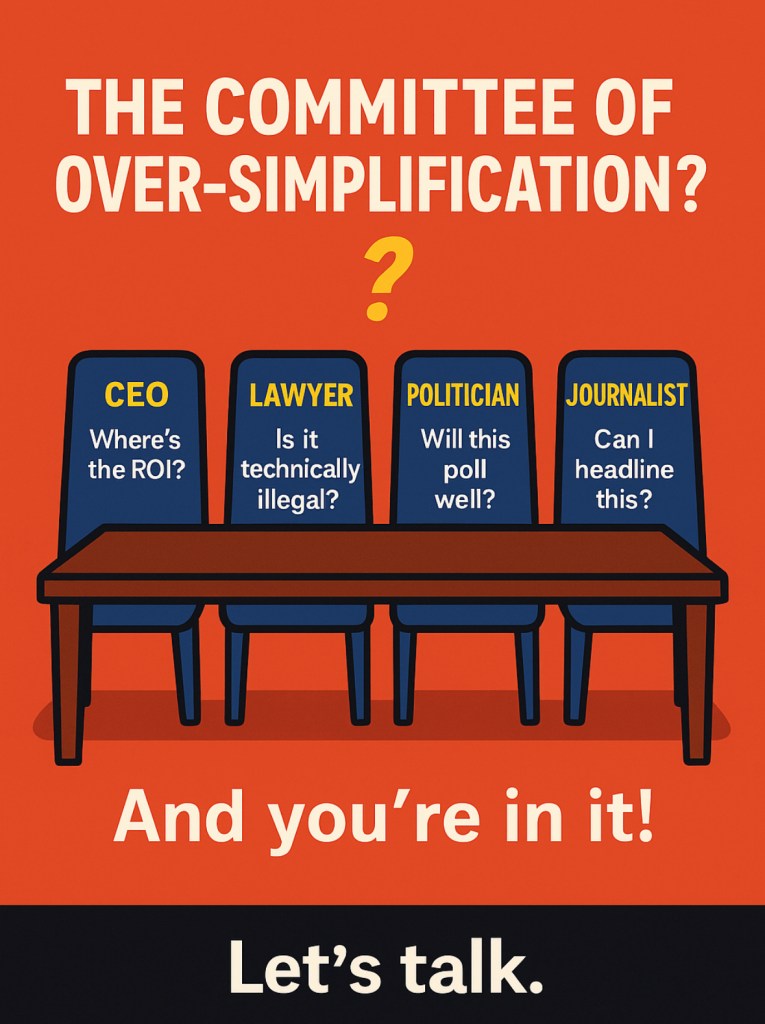
When we think of CEOs, lawyers, politicians, and journalists (or the Painful Four, as some may call them), we usually imagine vastly different worlds: boardrooms, courtrooms, parliaments, and press rooms. But beneath the surface, these professions often operate with surprisingly similar habits:

1- They tend to prefer binary answers in a world full of ambiguity (as a trained mathematician, physicist and computer scientist, working for more than 2 decades on the latest technologies, I have a healthy respect for the binary so, just hear me out, OK?).

2- They look for quick fixes rather than long-term systemic change.

3- They often rely on technical tricks or simplified narratives to gain leverage.

4- And sometimes, they rely on drama to get attention.

At their best, these habits can be used for real public good. At their worst, they amplify division, mask complexity, and concentrate value among a small few. The rest of the society is left with oversimplified stories and underwhelming outcomes. This becomes especially problematic (even dangerous) when these patterns affect how we use and regulate powerful new technologies such as Generative AI (that is for another post to delve into under Generative AI category. I started this post as a Rant so, forgive me for continuing the rant, I have a headache, remember?).

Now, let’s take a closer look.


CEOs: Impact Versus Optics

The Best Case
Yvon Chouinard, founder of Patagonia, transferred ownership of the company to a trust and nonprofit. His goal: ensure that all future profits are used to combat climate change and protect the planet. It turns out that, this was not a branding stunt or a tax dodge. It was a rejection of short-term profit-taking in favor of long-term environmental responsibility.

The Worst Case
Elizabeth Holmes promised revolutionary medical diagnostics. Instead, she sold a black-box illusion that fooled even experienced investors. The result was broken trust and burned billions.

The Pattern
We reward CEOs who pitch bold solutions, especially if they sound futuristic or, worse, unrealistic. We are seeing this “Impact vs Optics” dilemma playing itself out with the surge of Generative AI. Generative AI is based on probability and pattern prediction, not deterministic or logical approach. When we force complexity into simple business narratives, we end up creating tools and results that are misunderstood, misapplied, or mis-sold.


Lawyers: Justice Versus Justification

The Best Case
Bryan Stevenson, founder of the Equal Justice Initiative, uses the law to challenge systemic injustice. His work is slow, complex, and grounded in ethics.

The Worst Case
Legal teams working for Big Tobacco and Big Oil have spent decades defending harmful practices through legal loopholes. They win cases by focusing on technicalities, not on harm reduction. I often find myself admiring lawyers for their innovative work with the law, and the language, when using a nasty loophole, while, at the same time, feel bitterly disappointed at watching them justify the harm their brilliant legal maneuvering has done to their victims.

The Pattern
Legal culture often celebrates the win, not the impact. In the world of AI, where systems are embedded into compliance processes and automated decision-making, legal professionals may hide behind technical accuracy. But law, like code, reflects values. If ethics are not baked in, then technical correctness becomes a shield for irresponsible systems.


Politicians: Substance Versus Soundbites

The Best Case
Angela Merkel often took political risks to communicate complex decisions with clarity. Her leadership was not perfect, but it was thoughtful and consistent. It is hard to find a clear instance that she lied on anything for the sake of electability and that is a lot to say in this day and age.

The Worst Case
UK Brexiteers who used oversimplified slogans like “Get Brexit Done” (or some other version of it) to fuel an outcome that was deeply misunderstood, impractical, and wasteful. The consequences are still unfolding.

The Pattern
Political messaging favors clarity, not complexity. That becomes a problem when the issues are technical and long-term, such as climate change, managing misinformation, or designing resilient infrastructure. Simple slogans rarely make good policy, but here we are, looking to vote in the next (or the same) politicians based on how catchy their latest slogans are.


Journalists: Depth Versus Drama

The Best Case
Maria Ressa exposed authoritarian tactics and online disinformation with courage and depth. Her journalism is committed to complexity and accountability.

The Worst Case
On the opposite end, we have the example of the News of the World phone hacking scandal, where journalists illegally accessed voicemails of public figures and even a murdered teenager. The intrusion gave false hope to the victim’s family and interfered with the police investigation. What was framed as sensational reporting ended up exposing a toxic newsroom culture driven by profit, not public service, and ultimately led to the paper’s shutdown and a national inquiry into media ethics.

The Pattern
In a media economy based on attention, nuance is expensive. It is faster to simplify and it pays to be dramatic. As we all find new ways to get angry at each other, the temptation to blur the line between facts and fiction will grow. If journalists cannot hold the line, the public will not know what to trust.


So Who Is Really Responsible?

That is the hard part.

Is it the professionals? Or is it the rest of us, who reward these behaviors? And don’t forget that before professionals become professionals, they are the rest of us!

We are the ones who share clickbait. We demand certainty. We celebrate confidence even when it lacks substance. We are often too impatient for process, and too distracted for detail.

In a world of Deepfakes, synthetic media, and AI hallucinations, our demand for clarity over complexity is no longer just a personal habit. It is a societal vulnerability, a dangerous weakness that can only be exploited.

If we want better leaders, better laws, better journalism, and better outcomes, we need to become better at embracing complexity. That means making space for slower thinking. That means tolerating uncertainty. That means expecting more, not less, from the people and systems that shape our world.

The challenge is not just technical. It is cultural.


Where have you seen these patterns show up in your field? What would it take to shift the system rather than just the symptoms?

Subscribe to my blog or follow me on LinkedIn to get notified when I start ranting again!

25 Not-To-Dos of Data (Hello Blog World 🎉)

Starting any journey is tough, and more so when it involves data! Since I decided to join the Blog community I have been thinking actively of what to write about and it suddenly dawned on me that maybe highlighting a few Not-To-Dos is an easy way to start this Blog experiment. After all, it is always easier to tell people what not to do even if what not to do is what you actually do yourself (and know you should not do!). Hope you are feeling me. Anyway, here comes the first Blog post on this site so, hope you agree with the contents. Happy to hear from you to improve this and future articles. Oh, and remember, 25 is an arbitrary number. Somewhat round, not too small and not too big but we could go to 50 or more, as what is definitely not in short supply is bad data habits:-).

Finally, this is meant to be a way for me to get back to heavy writing, find like-minded colleagues and get positive feedback to learn. Each item really scratches the surface. I am hoping to pick a few of these short articles in the next few weeks and months to explore further. On the other hand, I have been thinking AI Ethics a lot recently so, maybe that will jump ahead. We will see. Too early to say how but now you know what the “plan” is!

For now, here is a list of 25 “Not-To-Dos” of data that (based on first hand experience over 2 decades) each of which, one way or another, affects effective Data Management:

  1. Neglecting Data Governance
    1. What is it: Failing to implement a framework that outlines how data is managed, who owns it, and how it’s used.
    2. Potential Impact: Poor data quality, lack of accountability, and compliance issues.
    3. Best Practice Fix: Establish a formal data governance framework with clear roles, policies, and ownership for all data assets.
  2. Ignoring Data Quality Management
    1. What is it: Not monitoring or enforcing the accuracy, completeness, and reliability of data.
    2. Potential Impact: Decisions based on inaccurate data lead to poor outcomes and financial losses.
    3. Example: JP Morgan’s London Whale incident where poor data quality in risk models led to $6 billion in losses (Google it!).
    4. Best Practice Fix: Implement regular data quality checks and establish clear KPIs around data integrity.
  3. Allowing/Encouraging/Tolerating Siloed Data
    1. What is it: Storing data in isolated systems where it cannot be easily accessed or shared.
    2. Potential Impact: Difficulty in gaining cross-departmental insights, leading to fragmented decision-making.
    3. Best Practice Fix: Break down data silos by using centralized platforms or data lakes that integrate all data sources. Remember a centralized solution is not necessarily physical (hope to touch on this one in more details sooner, rather than later).
  4. Over-Complicating Data Architecture
    1. What is it: Building overly complex data pipelines and systems that slow down the processing and decision-making.
    2. Potential Impact: Increased operational overhead and slower time to insights.
    3. Best Practice Fix: Design data architecture to be scalable and modular, focusing on simplicity and agility.
  5. Relying on Manual Data Processes
    1. What is it: Using manual data handling methods such as data entry and validation.
    2. Potential Impact: Human errors, inefficiencies, and high labor costs.
    3. Example: Just Google for examples of financial services firms who lost millions due to manual data entry errors in transactions.
    4. Best Practice Fix: Automate data workflows and validations to reduce human intervention and error.
  6. Lack of Standardization Across Data Sources
    1. What is it: Failing to standardize data formats, structures, and naming conventions across systems.
    2. Potential Impact: Inconsistent reporting, confusion, and difficulty in combining datasets. And maybe I should really say: too many reports for the same topics! I feel many know exactly what I mean here.
    3. Best Practice Fix: Establish data standards and enforce them across all data entry points and sources.
  7. Underinvesting in Data Security
    1. What is it: Neglecting to implement proper data security measures such as encryption, access control, and monitoring.
    2. Potential Impact: Data breaches, compliance violations, and loss of customer trust.
    3. Example: Equifax’s 2017 breach exposed 147 million records due to poor security practices.
    4. Best Practice Fix: Implement a multi-layered security approach with encryption, access controls, and real-time monitoring.
  8. Not Defining Clear Data Ownership
    1. What is it: Failing to assign responsibility for specific data assets to individuals or departments.
    2. Potential Impact: Lack of accountability, leading to mismanagement or neglect of critical data.
    3. Best Practice Fix: Assign data owners who are responsible for the quality, usage, and lifecycle of their data.
  9. Skipping Proper Data Documentation
    1. What is it: Failing to maintain documentation of data sources, transformations, and governance. This is one place that I go on about the dangers of “Agile Methodology”. Not that it is bad on its own, but documentation is typically the first thing that suffers when you seek agility in an organization!
    2. Potential Impact: Difficulties in understanding and trusting the data, leading to errors in decision-making.
    3. Best Practice Fix: Maintain comprehensive metadata and data lineage documentation to track the flow of data.
  10. Overlooking Data Privacy Regulations
    1. What is it: Ignoring or inadequately adhering to data privacy laws such as GDPR or CCPA.
    2. Potential Impact: Heavy fines, reputational damage, and loss of customer trust.
    3. Example: Google was fined $57 million for GDPR violations due to improper consent practices. An interesting one to Google about, of course:-).
    4. Best Practice Fix: Regularly audit data processes for compliance and update practices according to evolving regulations.
  11. Using Outdated or Unsupported Data Tools
    1. What is it: Relying on legacy systems or tools that are no longer maintained or secure.
    2. Potential Impact: System failures, security vulnerabilities, and reduced performance.
    3. Best Practice Fix: Regularly evaluate and update data infrastructure to ensure tools are modern, secure, and supported.
  12. Failing to Prioritize Data Integration
    1. What is it: Not connecting data from different systems, leading to fragmentation and incomplete insights.
    2. Potential Impact: Inaccurate reporting, poor customer service, and disjointed operations.
    3. Best Practice Fix: Use processes (ETL, etc.), middleware, or other relevant methodologies/technologies to integrate data from disparate sources into a single repository.
  13. Assuming All Data is Valuable
    1. What is it: Collecting and storing every piece of data without assessing its relevance or usefulness.
    2. Potential Impact: Increased storage costs, complexity in data management, and lower performance.
    3. Best Practice Fix: Focus on collecting high-quality, relevant data and regularly purge unnecessary or outdated data.
  14. Not Providing Data Literacy Training
    1. What is it: Failing to train employees on how to interpret and use data effectively.
    2. Potential Impact: Misinterpretation of data, poor decision-making, and underutilization of data tools.
    3. Best Practice Fix: Implement regular data literacy training programs tailored to different levels of expertise within the organization.
  15. Lack of Scalability in Data Infrastructure
    1. What is it: Building data systems that cannot grow with increasing data volumes or business needs.
    2. Potential Impact: Performance bottlenecks, downtime, and costly system overhauls.
    3. Best Practice Fix: Design data systems to scale dynamically by using cloud-native architectures and horizontal scaling techniques.
  16. Not Establishing Clear Data Use Policies
    1. What is it: Lacking formal policies on how data should be accessed, used, and shared within the organization.
    2. Potential Impact: Data misuse, security breaches, or legal violations.
    3. Best Practice Fix: Create comprehensive data use policies that define access levels, usage rules, and protocols for handling sensitive data.
  17. Rushing to Implement AI Without Clean Data
    1. What is it: Deploying AI models without ensuring the underlying data is accurate, consistent, and complete.
    2. Potential Impact: Poor AI model performance and inaccurate predictions.
    3. Example: IBM Watson for Oncology made incorrect treatment recommendations due to poor training data.
    4. Best Practice Fix: Focus on data cleansing and quality assurance before feeding data into AI models.
  18. Failing to Align Data Strategy with Business Objectives
    1. What is it: Implementing data initiatives without considering their alignment with the organization’s overall goals.
    2. Potential Impact: Underutilized systems, wasted resources, and missed business opportunities.
    3. Best Practice Fix: Develop a data strategy that directly supports key business objectives and regularly review its effectiveness.
  19. Not Archiving Old or Unused Data
    1. What is it: Retaining data indefinitely without determining its relevance or necessity.
    2. Potential Impact: Increased storage costs and legal risks from holding onto unnecessary or sensitive data.
    3. Best Practice Fix: Implement data lifecycle management policies that archive or delete old data based on usage patterns and regulatory requirements.
  20. Assuming Cloud Migration Solves All Data Problems
    1. What is it: Believing that moving data to the cloud will automatically resolve governance, quality, or integration issues.
    2. Potential Impact: Continued data problems, only now in a cloud environment, along with unexpected costs.
    3. Best Practice Fix: Plan cloud migrations carefully, addressing data governance and quality beforehand, and ensure cloud solutions are cost-effective and scalable.
  21. Lack of Real-Time Data Access
    1. What is it: Failing to provide access to real-time data, limiting the ability to respond quickly to changes.
    2. Potential Impact: Decision-making based on outdated information, leading to missed opportunities or poor outcomes.
    3. Best Practice Fix: Implement real-time data streaming or event-driven architectures to provide up-to-date insights.
  22. Relying Too Much on One Vendor
    1. What is it: Becoming overly dependent on a single vendor for critical data infrastructure or tools.
    2. Potential Impact: Vendor lock-in, pricing power shifts, and increased risk during outages or failures.
    3. Best Practice Fix: Diversify vendors and maintain vendor-neutral solutions where possible, with contingency plans in place.
  23. Over-Reliance on Shadow IT for Data Management
    1. What is it: Allowing departments to create and manage their own data solutions outside the oversight of the central IT team.
    2. Potential Impact: Uncontrolled data sprawl, security risks, and lack of governance.
    3. Best Practice Fix: Integrate shadow IT initiatives into the broader data strategy, providing IT governance while allowing flexibility.
  24. Not Having a Disaster Recovery Plan for Data
    1. What is it: Failing to create a backup or disaster recovery strategy for critical data systems.
    2. Potential Impact: Data loss, operational disruptions, and severe financial consequences.
    3. Example: In 2011, a Japanese automotive company lost critical data due to a natural disaster, as they had no offsite backup.
    4. Best Practice Fix: Establish a disaster recovery plan with regular backups (offsite or cloud-based) and conduct recovery drills to ensure business continuity.
  25. Failing to Automate Data Management
    1. What is it: Overlooking the automation of core data management functions such as metadata tracking, access control, lineage tracing, and policy enforcement, even when tools exist to streamline them.
    2. Potential Impact: Operational bottlenecks, inconsistent governance, reduced data trust, and higher risk of regulatory gaps. Manual oversight simply can’t keep pace with modern data volumes or complexity.
    3. Best Practice Fix: Adopt intelligent automation across your data management stack. Automation at the management layer ensures consistency, compliance, and scalability, not just efficiency.

This list is just the beginning. As I hinted at earlier, I plan to explore many of these issues in greater detail over time, and in doing so, I’ll inevitably cover a range of interconnected topics that shape the future of data and intelligent systems.

Here’s what you can expect from my blog posts going forward:

  • Data Strategy
  • AI Strategy
  • AI Ethics
  • Generative AI
  • Quantum Computing
  • Graph Models and Graph Thinking
  • General Reflections (which this first post falls into)

Whether you’re leading transformation efforts, building intelligent systems, or just trying to make better decisions with data, I hope you’ll find ideas here that challenge, clarify, and contribute.

See you in the next post.