
Good day, my good readers!
I woke up with a headache today (it happens frequently, specially when I go to bed reading about the world events) and immediately found myself wrestling with a dirty the following “dirty” thoughts:
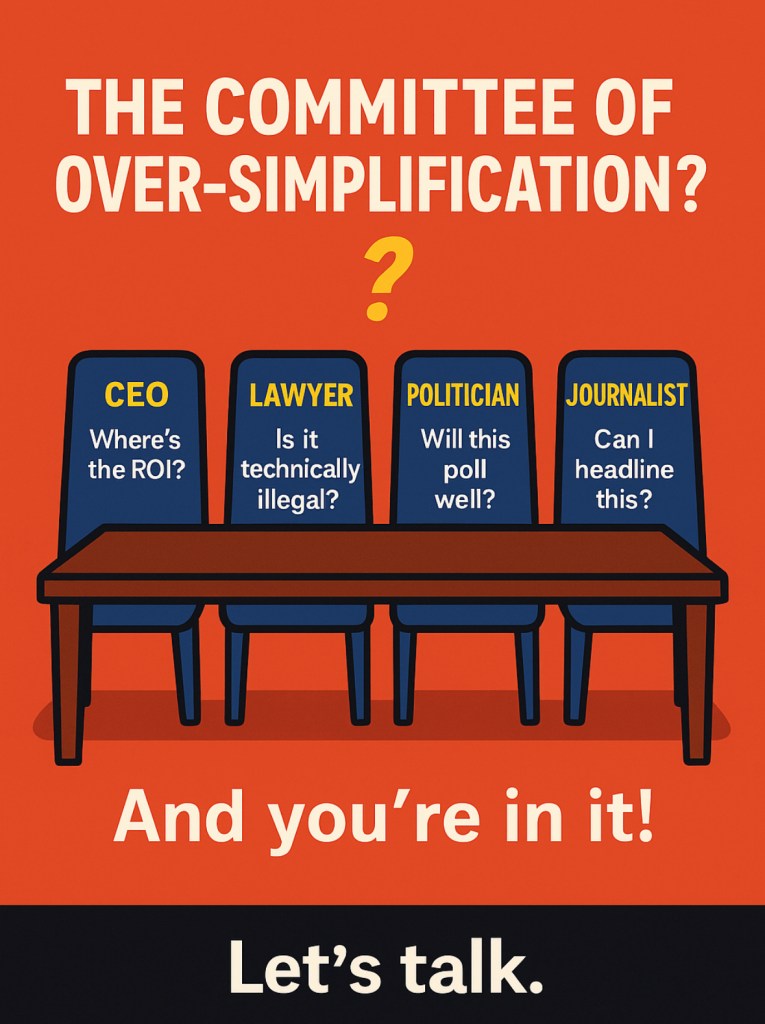
When we think of CEOs, lawyers, politicians, and journalists (or the Painful Four, as some may call them), we usually imagine vastly different worlds: boardrooms, courtrooms, parliaments, and press rooms. But beneath the surface, these professions often operate with surprisingly similar habits:
1- They tend to prefer binary answers in a world full of ambiguity (as a trained mathematician, physicist and computer scientist, working for more than 2 decades on the latest technologies, I have a healthy respect for the binary so, just hear me out, OK?).
2- They look for quick fixes rather than long-term systemic change.
3- They often rely on technical tricks or simplified narratives to gain leverage.
4- And sometimes, they rely on drama to get attention.
At their best, these habits can be used for real public good. At their worst, they amplify division, mask complexity, and concentrate value among a small few. The rest of the society is left with oversimplified stories and underwhelming outcomes. This becomes especially problematic (even dangerous) when these patterns affect how we use and regulate powerful new technologies such as Generative AI (that is for another post to delve into under Generative AI category. I started this post as a Rant so, forgive me for continuing the rant, I have a headache, remember?).
Now, let’s take a closer look.
CEOs: Impact Versus Optics
The Best Case
Yvon Chouinard, founder of Patagonia, transferred ownership of the company to a trust and nonprofit. His goal: ensure that all future profits are used to combat climate change and protect the planet. It turns out that, this was not a branding stunt or a tax dodge. It was a rejection of short-term profit-taking in favor of long-term environmental responsibility.
The Worst Case
Elizabeth Holmes promised revolutionary medical diagnostics. Instead, she sold a black-box illusion that fooled even experienced investors. The result was broken trust and burned billions.
The Pattern
We reward CEOs who pitch bold solutions, especially if they sound futuristic or, worse, unrealistic. We are seeing this “Impact vs Optics” dilemma playing itself out with the surge of Generative AI. Generative AI is based on probability and pattern prediction, not deterministic or logical approach. When we force complexity into simple business narratives, we end up creating tools and results that are misunderstood, misapplied, or mis-sold.
Lawyers: Justice Versus Justification
The Best Case
Bryan Stevenson, founder of the Equal Justice Initiative, uses the law to challenge systemic injustice. His work is slow, complex, and grounded in ethics.
The Worst Case
Legal teams working for Big Tobacco and Big Oil have spent decades defending harmful practices through legal loopholes. They win cases by focusing on technicalities, not on harm reduction. I often find myself admiring lawyers for their innovative work with the law, and the language, when using a nasty loophole, while, at the same time, feel bitterly disappointed at watching them justify the harm their brilliant legal maneuvering has done to their victims.
The Pattern
Legal culture often celebrates the win, not the impact. In the world of AI, where systems are embedded into compliance processes and automated decision-making, legal professionals may hide behind technical accuracy. But law, like code, reflects values. If ethics are not baked in, then technical correctness becomes a shield for irresponsible systems.
Politicians: Substance Versus Soundbites
The Best Case
Angela Merkel often took political risks to communicate complex decisions with clarity. Her leadership was not perfect, but it was thoughtful and consistent. It is hard to find a clear instance that she lied on anything for the sake of electability and that is a lot to say in this day and age.
The Worst Case
UK Brexiteers who used oversimplified slogans like “Get Brexit Done” (or some other version of it) to fuel an outcome that was deeply misunderstood, impractical, and wasteful. The consequences are still unfolding.
The Pattern
Political messaging favors clarity, not complexity. That becomes a problem when the issues are technical and long-term, such as climate change, managing misinformation, or designing resilient infrastructure. Simple slogans rarely make good policy, but here we are, looking to vote in the next (or the same) politicians based on how catchy their latest slogans are.
Journalists: Depth Versus Drama
The Best Case
Maria Ressa exposed authoritarian tactics and online disinformation with courage and depth. Her journalism is committed to complexity and accountability.
The Worst Case
On the opposite end, we have the example of the News of the World phone hacking scandal, where journalists illegally accessed voicemails of public figures and even a murdered teenager. The intrusion gave false hope to the victim’s family and interfered with the police investigation. What was framed as sensational reporting ended up exposing a toxic newsroom culture driven by profit, not public service, and ultimately led to the paper’s shutdown and a national inquiry into media ethics.
The Pattern
In a media economy based on attention, nuance is expensive. It is faster to simplify and it pays to be dramatic. As we all find new ways to get angry at each other, the temptation to blur the line between facts and fiction will grow. If journalists cannot hold the line, the public will not know what to trust.
So Who Is Really Responsible?
That is the hard part.
Is it the professionals? Or is it the rest of us, who reward these behaviors? And don’t forget that before professionals become professionals, they are the rest of us!
We are the ones who share clickbait. We demand certainty. We celebrate confidence even when it lacks substance. We are often too impatient for process, and too distracted for detail.
In a world of Deepfakes, synthetic media, and AI hallucinations, our demand for clarity over complexity is no longer just a personal habit. It is a societal vulnerability, a dangerous weakness that can only be exploited.
If we want better leaders, better laws, better journalism, and better outcomes, we need to become better at embracing complexity. That means making space for slower thinking. That means tolerating uncertainty. That means expecting more, not less, from the people and systems that shape our world.
The challenge is not just technical. It is cultural.
Where have you seen these patterns show up in your field? What would it take to shift the system rather than just the symptoms?
Subscribe to my blog or follow me on LinkedIn to get notified when I start ranting again!
 Parviz Foroughian